
Drum Chipper NZ — What Contractors Need to Know Before Buying a Heizohack
By Asher Bowyer, ALFA Arb and Forestry Equipment
When you're running a chipping operation at volume — forestry slash, land clearing, biomass contracts, roadside clearing — the machine you choose determines whether the job is profitable. Get the spec wrong and you're either underpowered for the material, or you've overcapitalised on something bigger than the work justifies. This guide covers what matters when you're looking at an industrial drum chipper in the NZ and Australian market.

What Is a Drum Chipper?
A drum chipper uses a large, heavy rotating steel drum with hardened blades bolted to its outer surface. As the drum spins, it pulls material inward and chips it against a stationary anvil. The key engineering advantage over disc chippers is the wide infeed throat — on a machine like the Heizohack HM 10-500, that's an 877mm infeed width and 800mm infeed height. You're feeding full-sized timber, not sizing it down first.
The flywheel mass is what keeps a drum chipper running consistently through heavy, irregular material. On the HM 10-500, the flywheel weighs 1,000kg and measures 1,370mm in diameter. That mass maintains momentum through dense hardwood and forked material that would stall a lighter machine. The low-drag drum rotor design also means the machine runs efficiently at relatively low power input — it doesn't need to fight its way through timber, it pulls it in.
Drum vs Disc — The Honest Comparison
Disc chippers produce a more uniform chip size and suit operations where chip specification is tightly controlled — sawmills, specific pulp grades, some pellet production. They work well for arborist material: consistent-diameter branch work processed at moderate volume.
Drum chippers handle what disc chippers struggle with. Twisted timber, forked tops, brash, mixed-diameter slash — the wide throat and aggressive feed system of a drum chipper takes it all. The trade-off is that chip consistency, while good, isn't quite as precise as a quality disc machine. For most NZ forestry contractors, biomass producers and land clearing operations, that's not a meaningful trade-off — you're producing chip for boiler feed, animal bedding, mulch or biomass supply, not a tightly specified pulp grade.
The right question is what your end product requires. If the customer needs an engineered chip to a precise specification, a disc machine may be more appropriate. If you're processing whole trees at a fast rate and producing quality dimensional chip for biomass or general use, a drum chipper is the natural choice.
The NZ Drum Chipper Market — Where Heizohack Sits
The market for industrial drum chippers in NZ covers a wide range. At the large end — whole tree processors from Morbark, Bandit and Vermeer — you're looking at machines designed for major forestry operations processing thousands of tonnes per season. These are serious machines for serious scale, and they're priced accordingly.
Heizohack sits in the contractor and cooperative tier — professional machines built for continuous heavy-duty operation that don't require the scale of a dedicated forestry company to justify. The Forestry Journal describes them as "a firm favourite amongst biomass contractors producing chip to sell, boiler owners who wish to produce chips for their own use, site-clearance contractors, and tree surgeons alike — as there is a model to suit every requirement." That's an accurate description of the market these machines serve.
For NZ and Australian operators, Heizohack's position in the market makes sense: genuine industrial throughput, German build quality, and a price point that works for contractors running a business rather than a forestry conglomerate.
ALFA Equipment is the exclusive Heizohack distributor for New Zealand and Australia. We supply, commission, and support the full range.
Heizohack — The Range
Heizomat, the German manufacturer behind Heizohack, has been building drum chippers since 1982. The machines are manufactured at their facilities in Gunzenhausen/Maicha and Heidenheim, and are in active use across the UK, Europe, Canada and increasingly in NZ and Australia.
The range breaks down into several main configurations:
Crane-fed machines — the HM 8-500, HM 10-500 and HM 14-860 series. These are trailer-mounted machines fed by a loading crane, designed for processing whole trees, logs and heavy slash. The crane feeds material directly into the infeed — the operator controls feed speed and direction from a remote control in the tractor cab. These are the machines most NZ forestry and biomass contractors are looking at.
Truck-mounted chippers — the HM 14-860 KL series, mounted on a Mercedes-Benz Actros 6x6 chassis. The truck can be moved while the chipper is running, thanks to the NMV gearbox. These suit operations that move frequently between sites and need the whole setup self-contained.
Pallet chippers — the SPE series processes waste timber, pallets and construction offcuts into biomass chip. Different application, different buyer — but worth knowing the range extends this far.
The HM 10-500 — The Machine We Have In Stock
The HM 10-500 is one of Heizohack's most popular contractor models globally, proven across the UK and Europe in general contracting, forestry and biomass work. We have one in stock in New Zealand right now.
Verified specifications:
Infeed height: 800mm
Infeed width: 877mm
Chipping drum: 500mm diameter
Flywheel: 1,370mm diameter, 1,000kg mass
Standard sieve: 45/60mm
Conveyor belt: 900mm
Transport dimensions: 5,160mm length, 2,700mm width, 2,900mm height
Weight: approximately 8.5 tonnes
Output: 60–80m³/hour working rate; up to 100m³/hour on clean, straight timber
A word on that output figure: on a good day with straight, clean material it will put out up to 100 cubic metres an hour. On real mixed material — slash, forked timber, varying diameter — the working rate is 60–80m³/hour. Either figure is significant output for a machine this size, and more than other machines in its class.
The blade system is worth noting for anyone making a long-term cost calculation. Heizohack blades are sharpened directly on the drum — no specialist equipment required, the job takes minutes on site. Multiple small blades mean no balancing issues at replacement time, and the replacement cost is straightforward. On a machine running continuous production hours, that matters.
The HM 10-500 can be configured with a three-motor cone splitter for processing oversized or difficult timber. It's tandem-axle trailer mounted, road-legal, and can be equipped with a telescopic ejection chute (extending to 5.7m) for loading trailers at height.
What Operations This Machine Suits
Forestry contractors processing slash, timber tops and whole trees as part of harvesting operations or post-harvest cleanup. The crane-fed setup handles the material mix you get in real forestry work.
Land clearing contractors dealing with whole trees and heavy mixed material. The wide infeed throat and aggressive feed system handle the bulky, irregular material that characterises land clearing without constant operator intervention.
Biomass production — whether you're supplying a biomass boiler, producing fuel chip for sale, or running an on-farm energy system. The consistent chip size from the sieve-controlled drum suits the grade requirements of most biomass boilers and buyers.
Councils and roading contractors managing roadside vegetation, utility corridor clearing and timber disposal. The road-legal trailer configuration suits operations that move between sites.
On-farm chip production — some operators use these machines to produce woodchip for animal bedding, stand-off pads or calf sheds from their own woodlot. At 60–80m³/hour, producing your own supply works out at roughly half the cost of buying and trucking it in.
The Integrated System — Heizohack, PALMS and JAKE
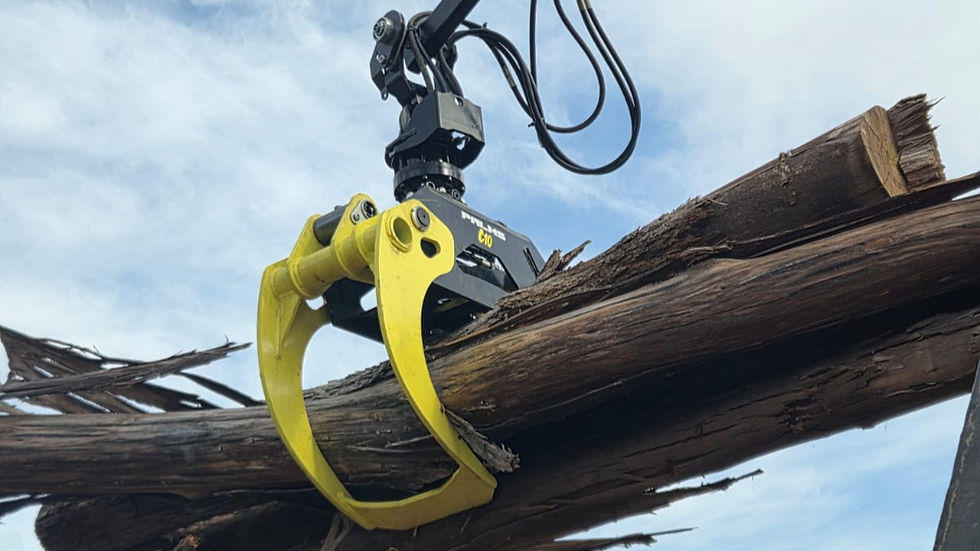
A Heizohack chipper works most effectively as part of a complete timber handling system. At ALFA Equipment, we supply the full setup: Heizohack drum chippers paired with PALMS forestry cranes for crane-fed operation, mounted using JAKE tractor mounting systems that allow the crane and chipper to run off a single tractor.
At Fieldays 2026 we had the integrated Heizohack, PALMS and JAKE system on display together. That combination — one tractor, complete timber handling and chipping capability — is what contractors running efficient operations are increasingly moving toward.
The HM 10-500 Is In Stock Now
The machine is in our yard in New Zealand and available for demonstration. If you want to see what 60–80m³ per hour looks like on real timber, we can arrange that.
We're the exclusive Heizohack distributor for New Zealand and Australia. We provide sales, demonstrations, commissioning, finance options, genuine parts and nationwide support. When the in-stock machine goes, the next one is a shipping lead-time away.
Frequently Asked Questions
What is a drum chipper and how does it work? A drum chipper uses a large rotating steel drum fitted with hardened blades to process timber. As the drum spins it pulls material inward and chips it against a stationary anvil. The wide infeed throat and heavy flywheel mass allow drum chippers to handle whole trees, large logs and forestry slash at high volume and consistent throughput.
What is the difference between a drum chipper and a disc chipper? A disc chipper uses a heavy steel disc with knives on its face and produces very consistent chip sizes — suited to operations where chip specification is tightly controlled. A drum chipper handles significantly larger and more irregular material with a wider infeed throat and higher throughput. For forestry contracting, land clearing and biomass production at scale, a drum chipper is the right choice. For precise chip specification work, a disc machine may be more appropriate.
How much output does a Heizohack drum chipper produce? The HM 10-500 produces 60–80m³ per hour at working rate on real mixed material, and up to 100m³ per hour on clean straight timber. The HM 14-860 produces higher throughput again for larger-scale operations.
What drum chippers are available in New Zealand? ALFA Equipment is the exclusive distributor of Heizohack industrial drum chippers for New Zealand and Australia. The Heizohack range includes crane-fed trailer models, truck-mounted chippers and pallet chippers. We currently have an HM 10-500 in stock in New Zealand.
Is a drum chipper better than a disc chipper for forestry work? For high-volume forestry, land clearing and biomass production, the drum chipper's wide infeed throat handles whole trees and irregular material that slows a disc machine, and throughput is significantly higher. Disc chippers suit operations where chip uniformity to a precise specification is the primary requirement.
Can I get parts and support for a Heizohack in NZ? Yes — ALFA Equipment carries genuine Heizohack spare parts and provides commissioning, servicing and ongoing technical support across New Zealand and Australia. Heizohack blades can be sharpened on the drum on site without specialist equipment, which simplifies maintenance in the field.
What is the infeed capacity of Heizohack drum chippers? The Heizohack range handles material up to 80cm diameter. The HM 10-500 has an 877mm infeed width and 800mm infeed height. The HM 14-860 handles larger material again for heavy-volume operations.
ALFA Equipment — exclusive Heizohack distributor for New Zealand and Australia. View the Heizohack range → | Contact us → | PALMS forestry cranes →


Comments